

Every year as 14 April Ambedkar Jayanti arrives, India pauses to reflect, celebrate, and renew its commitment to the ideals of true equality and justice. Marking the birth anniversary of Dr. Bhimrao Ramji Ambedkar, this significant day honors a man who was far more than just the “Father of the Indian Constitution.” Babasaheb—as he is affectionately known—was a colossal scholar, a pioneering economist, a fierce social reformer, and a brilliant legal mind who dedicated his entire life to uplifting the downtrodden and fighting for basic human rights.
As we celebrate Ambedkar Jayanti in 2026, his teachings seem not just historical, but remarkably predictive and essential for the modern world. In a climate where social and economic equality are still actively discussed globally, looking back at the life of Dr. Ambedkar provides a crucial roadmap for current and future generations.
This comprehensive article explores the life, legacy, and enduring relevance of Dr. B.R. Ambedkar, offering a simple yet profound understanding of the man who reshaped a nation.
14 April Ambedkar Jayanti: The Early Struggles That Forged His Vision
To truly appreciate the monumental achievements of Dr. Ambedkar, we must first understand the context into which he was born. Born on April 14, 1891, in Mhow, Madhya Pradesh, Bhimrao was the 14th child of Ramji Maloji Sakpal and Bhimabai. His family belonged to the Mahar caste, which was considered “untouchable” in the rigid social hierarchy of the time.
Experiencing “Untouchability” Firsthand
From a very young age, Bhimrao was made aware of his social standing, not by choice, but through exclusion. At school, he was forced to sit on the floor, away from the caste-Hindu students. He was not allowed to touch the public water tap; someone of a “higher” caste had to pour water for him. If the school peon was absent, Bhimrao went thirsty.
These early humiliations, rather than breaking his spirit, fueled a fierce desire to challenge the system. He realized that the only path to liberation from this systemic oppression was through education.
The Power of Education
Supported by visionary rulers like the Maharaja of Baroda, Ambedkar pursued his studies with insatiable hunger. He broke caste barriers by becoming one of the first Dalits (formerly untouchables) to gain a university degree.
His quest for knowledge took him globally. He earned multiple doctorates from prestigious institutions like Columbia University in New York and the London School of Economics. This exposure to Western democratic ideals, civil liberties, and equality contrasted sharply with the social realities of India, further cementing his resolve to fight for systemic change.
The Social Reformer: Reflecting on His Fight Against Caste this 14 April Ambedkar Jayanti
Upon returning to India, Dr. Ambedkar could have used his qualifications to earn a comfortable living. Instead, he chose the road less traveled—the long, difficult fight for social justice.
Organized Activism
Ambedkar understood that social change requires both legal structure and organized resistance. He established organizations like the Bahishkrit Hitakarini Sabha (Group for the Welfare of the Excluded) to advocate for the rights of the depressed classes.
Through journals like Mooknayak (Leader of the Dumb), he amplified the voices of those who had been silenced for centuries. His primary strategy was simple yet revolutionary: educate the masses about their rights and teach them to demand equality, not charity.
Historic Satyagrahas: Claiming Public Spaces
Two specific events in his activist career highlight his practical approach to challenging inequality:
- Mahad Satyagraha (1927): Public drinking water tanks were often restricted for Dalits. Dr. Ambedkar led thousands to Chowdar Tank in Mahad (Maharashtra) and formally drank water from it. This wasn’t just about water; it was a powerful assertion of a fundamental human right to share public spaces.
- Kalaram Temple Entry Movement (1930): He led a long, non-violent movement demanding that Dalits be allowed entry into the Kalaram Temple in Nashik.
These movements brought the atrocities of the caste system onto the national stage, challenging the conscience of independent India’s founders.
The Political Voice: Celebrating His Fight for Representation on 14 April Ambedkar Jayanti
Ambedkar quickly realized that while social reform was necessary, political power was critical to ensure lasting equality. This led to his famous disagreements with Mahatma Gandhi regarding the best approach to uplift Dalits.
The Poona Pact (1932)
While Dr. Ambedkar advocated for “separate electorates” (where only Dalits would vote for Dalit representatives) to ensure genuine representation, Gandhi opposed this, believing it would permanently divide Hindu society. Gandhi went on a hunger strike, leading to intense pressure on Ambedkar.
The result was the Poona Pact, a compromise where separate electorates were dropped in exchange for “reserved seats” within the general legislative bodies for Dalits. This agreement significantly shaped the political landscape of representation that exists in India today.
Architect of the Nation: Drafting the Indian Constitution
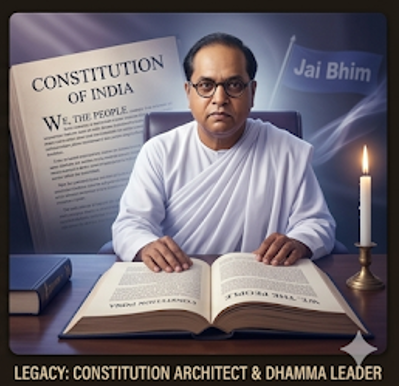
When India gained independence in 1947, the first Prime Minister, Jawaharlal Nehru, invited Dr. Ambedkar to join the cabinet as the nation’s first Law Minister. Perhaps more significantly, he was appointed Chairman of the Drafting Committee for the Constitution.
This role was the culmination of his life’s work. It was his chance to translate his scholarly knowledge and personal experience into the foundational document of a new, democratic nation.
Anchoring Rights and Abolishing Discrimination
Under his leadership, the Drafting Committee produced a document that was remarkably progressive. Key contributions include:
- Abolition of Untouchability (Article 17): Formally making the practice of untouchability an offense.
- Fundamental Rights: guaranteeing equality before the law, freedom of speech, and protection against discrimination on the grounds of religion, race, caste, or sex.
- Affirmative Action: Introducing reservations in education and public employment for Scheduled Castes and Scheduled Tribes to correct historical wrongs.
Dr. Ambedkar described the Fundamental Rights as the “heart and soul” of the Constitution, viewing them as essential checks against potential tyranny, whether from the government or societal majorities.
Advancing Women’s Rights
A lesser-known, yet incredibly significant part of Babasaheb’s work was his championship of women’s rights. He drafted the Hindu Code Bill, which aimed to modernize family laws, granting women equal rights to inheritance, marriage flexibility, and custody. When the bill faced political opposition, he resigned from his position as Law Minister in protest, showcasing his unyielding commitment to justice. Many elements of this bill were later adopted as separate pieces of legislation.
The Economics Pioneer and Labor Reformer
Often overshadowed by his social work, Dr. Ambedkar was also an exceptional economist. His academic theses on the problems of Indian currency and provincial finance provided fundamental insights into the Indian economy.
Contribution to the RBI
His economic insights were so profound that the Royal Commission on Indian Currency and Finance used his work as a cornerstone for the creation of India’s central banking institution, the Reserve Bank of India (RBI).
Labour Rights
As a member of the Viceroy’s Executive Council for Labour, he introduced reforms that are standard today but were revolutionary then, including the 8-hour workday, minimum wages, leave benefits, and equal pay for equal work for women.
The Conversion to Buddhism: A Spiritual Home for Liberty
Towards the end of his life, Dr. Ambedkar concluded that the caste system was deeply embedded in Hinduism and that genuine equality for Dalits within that framework was impossible.
Having spent decades trying to reform Hindu society, he decided to “reject the caste religion” entirely. On October 14, 1956, in Nagpur, he, along with hundreds of thousands of followers, converted to Buddhism. He chose Buddhism because he believed its central tenets of Pragna (superstition-free wisdom), Karuna (compassion), and Samata (equality) provided the ideal spiritual framework for a just society. He viewed Buddhism not just as a religion, but as a moral force for social liberty.
Dr. Ambedkar passed away peacefully in his sleep on December 6, 1956, only a few weeks after this historic conversion.
Ambedkar Jayanti 2026: Why His Legacy is Still Alive
Celebrating Ambedkar Jayanti isn’t just a state ritual. It is a moment for every Indian to assess how close the nation has come to fulfilling the dream of Babasaheb.
A Beacon for Nagpur and Beyond
Dr. Ambedkar’s final decision to convert to Buddhism occurred in Nagpur, Maharashtra. Today, places like Deekshabhoomi in Nagpur stand as monumental tributes to this event, drawing millions who seek inspiration from his life. In 2026, the crowds that gather are not just diverse in terms of social background, but also increasingly global, reflecting the worldwide recognition of his social justice philosophy.
His Slogan: Educate, Agitate, Organize
This famous phrase remains a rallying cry for activists everywhere.
- Educate: Education is the foundational tool for empowerment. In 2026, this means advocating not just for literacy, but for critical thinking and digital fluency to challenge modern misinformation.
- Agitate: This doesn’t mean violence. It means being socially aware, speaking out against injustice, and actively participating in democratic processes.
- Organize: Unity is strength. Social change requires collective effort and systematic organization.
The Constitution as a Living Document
The Constitution of India, crafted under his guidance, has proven to be incredibly resilient. It has navigated countless political challenges, societal shifts, and technological advancements. The legal protections he championed are actively referenced in courtrooms today to protect the rights of minorities, maintain the secular fabric of the nation, and ensure gender equality.
Conclusion: Honoring Babasaheb on April 14, 2026
Dr. B.R. Ambedkar was a visionary who saw the future of India long before it came to be. He was a champion of the weak, a scholar of the strong, and the legal mind that gave India its enduring framework.
Ambedkar Jayanti 2026 is an opportunity to look beyond the statues and the slogans. It’s a chance to read his writings, understand his philosophy, and most importantly, adopt his commitment to social justice in our own lives.
He once remarked, “I measure the progress of a community by the degree of progress which women have achieved.” This metric, among many others he provided, remains essential today. As we celebrate this day, let us all renew our dedication to building an India that is truly free, equal, and just for every single citizen, precisely as Babasaheb envisioned.
Jay Bhim! Jay Hind!